Earth Day was April 22, 2010, but we can celebrate it year round by practicing little green habits every day.
Every Day is Earth Day
Friday, April 23, 2010

0
comments
|
Labels:
corn,
earth day,
eco-friendly,
eco-friendly toilet paper,
meat,
plastic,
produce,
recycle,
Reduce,
reuse,
sustainability
Earth Day 2010
Earth Day is an opportunity to remember that the three R's are prioritized. Reduce, reuse and recycle is a mantra with alliteration and purpose.
Reduce
Buy less. Buy less food. The sale on crackers doesn't do anyone much good if they sit stale in the cupboard. Even the greatest outfits can be lost in an over stuffed closet - what a waste! The best part of reducing is saving money. For every reduction, a positive action will reveal itself: less driving leads to more walking or biking and a healthier physique.
Reuse
One may reuse by using the same item for its original function again and again, or by re-purposing the item. A plastic sandwich bag used for dry items like chips can usually be reused without even needing a rinse. Clothing that is not dirty can be worn again before getting tossed into the hamper. Then, there's crafts and finding new uses for old things. With the internet, one doesn't need to be creative; just do a Google search and follow the directions of your selected craft. Here's one for turning old toothbrushes into bracelets.

Recycle
When nothing else can be done, dispose of the product properly. Some recycling centers will offer incentives to get hazardous items to the right facility. For example, Clark Public Utilities customers in Clark County, Wash. may receive a new compact fluorescent bulb for each burnt-out, unbroken one they bring in.
Reduce
Buy less. Buy less food. The sale on crackers doesn't do anyone much good if they sit stale in the cupboard. Even the greatest outfits can be lost in an over stuffed closet - what a waste! The best part of reducing is saving money. For every reduction, a positive action will reveal itself: less driving leads to more walking or biking and a healthier physique.
Reuse
One may reuse by using the same item for its original function again and again, or by re-purposing the item. A plastic sandwich bag used for dry items like chips can usually be reused without even needing a rinse. Clothing that is not dirty can be worn again before getting tossed into the hamper. Then, there's crafts and finding new uses for old things. With the internet, one doesn't need to be creative; just do a Google search and follow the directions of your selected craft. Here's one for turning old toothbrushes into bracelets.

Recycle
When nothing else can be done, dispose of the product properly. Some recycling centers will offer incentives to get hazardous items to the right facility. For example, Clark Public Utilities customers in Clark County, Wash. may receive a new compact fluorescent bulb for each burnt-out, unbroken one they bring in.
Which plastics are best?
FACT: Plastics can take up to 400 years to break down. Almost all the plastics ever made can still be found somewhere.
Plastic manufacturers throw around words like degradable, compostable and biodegradable, but what do these really mean? These are all words that mean that the plastics break down, right? There is a difference between all of these and they should play a role in your purchasing decisions.
Biodegradable products break down from naturally occurring microorganisms over a period of time. They are often made from plant and animal sources and some examples of biodegradable products include paper, vegetable scraps and some plastics made from ingredients like corn starch.
BUT: When added to landfills in the oxygen depleted environment, biodegradable waste breaks down under anaerobic conditions and creates methane, which is a greenhouse gas with over 62 times the global warming potential of carbon dioxide. Biodegradable waste can also contain toxins such as heavy metals and pesticides.
Degradable plastics are oil based and break down through chemical reactions rather that the activity of microorganisms, so they can degrade in an anaerobic environment into water, carbon dioxide, biomass and trace elements.
Compostable plastics are close to biodegradable plastics but "greener", according to a Green Living Tips article. For plastic to be considered compostable, it must be able to break down into carbon dioxide, water and biomass at the same rate as paper. It also needs to look like compost, should support plant life, and not produce any toxic material. Compostable products are usually made from plant materials like corn, potato, cellulose, soy and sugar.
THE BOTTOM LINE: In some scenarios the fossil fuel input is greater in making these "green plastics" when compared to the equivalent in crude oil basted plastic product.
Plastic manufacturers throw around words like degradable, compostable and biodegradable, but what do these really mean? These are all words that mean that the plastics break down, right? There is a difference between all of these and they should play a role in your purchasing decisions.
Biodegradable products break down from naturally occurring microorganisms over a period of time. They are often made from plant and animal sources and some examples of biodegradable products include paper, vegetable scraps and some plastics made from ingredients like corn starch.
BUT: When added to landfills in the oxygen depleted environment, biodegradable waste breaks down under anaerobic conditions and creates methane, which is a greenhouse gas with over 62 times the global warming potential of carbon dioxide. Biodegradable waste can also contain toxins such as heavy metals and pesticides.
Degradable plastics are oil based and break down through chemical reactions rather that the activity of microorganisms, so they can degrade in an anaerobic environment into water, carbon dioxide, biomass and trace elements.
Compostable plastics are close to biodegradable plastics but "greener", according to a Green Living Tips article. For plastic to be considered compostable, it must be able to break down into carbon dioxide, water and biomass at the same rate as paper. It also needs to look like compost, should support plant life, and not produce any toxic material. Compostable products are usually made from plant materials like corn, potato, cellulose, soy and sugar.
THE BOTTOM LINE: In some scenarios the fossil fuel input is greater in making these "green plastics" when compared to the equivalent in crude oil basted plastic product.
Sunday, April 18, 2010
0
comments
|
Labels:
consumer products,
eco-friendly products,
energy,
plastic,
waste
WSU Student Designs Eco-Jeans
"I aimed to design American-made environmentally sustainable jeans,” Wilmot said.
Health Care Improves Environmental Health

Kaiser Permanente, the largest non-profit HMO in the country is going solar. They will power 15 of their facilities in
This agreement with Recurrent Energy, an independent power producer and a developer of solar power projects, will launch one of the largest sustainable energy programs in
“What’s good for the environment is good for our health,” said Raymond Baxer, PhD, senior vice president, Community Benefit, Research and Health Policy at Kaiser Permanente in a press release. “By expanding the use of solar power, Kaiser Permanente is demonstrating its commitment to greening its energy portfolio and reducing its carbon footprint."
The solar power systems at Kaiser Permanente will produce an average of 10 percent of the power they use, equivalent to electricity used by about 1,900 homes a year.
As the result of green building efforts, Kaiser Permanente:
-Saves more than $10 million per year through energy conservation strategies. A leader in environmental health care and construction, Kaiser Permanente has committed to drastically reducing its use of fossil fuels and slowing energy growth over the next 10 years.
-Will use sustainable design and construction practices to complete roughly 6.7 million square feet of new construction in the next seven years.
-Eliminated the purchase and disposal of 40 tons of harmful chemicals.
Read more about this project here.
Greenest cars are reused

Anyone with money can buy a green car like a Prius or a Tango. For those of us with smaller egos and budgets, buying used, efficient cars can be the best route.
The Green Car Company of Bellevue, Wash. a jewel when it comes to green, used car shopping. Their inventory is not extensive, but nonetheless exemplary including Smart Cars starting at $11,999 and a bio diesel-ready Volkswagen Golf for $9,999.
The Green Car Company also resells fuel efficient cars that are less glamorous than bio diesel and hybrids, but still in good condition. These cars have decent prices, but the price really depends on the mileage.
However, if you're not convinced that a green car is better the second time around, there are many canons of shiny, new green cars like this list from The Daily Green.
Chickens at home, a green trifecta

I love farm fresh eggs. The different colors, the bright, golden yokes and the flavor make them worth the cost. However, I never thought about having my own chickens. The ruling excuse being that I don't live on a farm. But now, clever chicken coop design is moving chickens to a neighborhood near you.
With Catawaba ConvertiCoops building the "Cadillac" of hen houses, the disincentives for raising urban chickens are thinning out. These portable chicken coops are aesthetically pleasing with a touch of rustic charm. Yet they are also functional. The coops are portable which allows the chickens to fertilize and eat slugs anywhere in the yard. Handcrafted Coops offers similar designs. Of course for do-it-yourself types there are plenty of guidebooks and other resources. Here's a short video of some very attractive hen houses
Fresh eggs, natural fertilizer and safe slug remover is the green trifecta that chickens bring to the table.
The Bloom Box... still a hot option?

Many people have seen the Bloom Box in newspapers and TV spots like 60 Minutes. FedEx, WalMart, Staples, EBay and Google are using Bloom Boxes. Some of these companies are coming up on their one year anniversaries with Bloom Energy. Where does the Bloom Box stand now?
Just a few weeks after entering the limelight, the press energy surrounding the fuel cells has died down. Most articles now are concerned with potential problems. A key issue is Blooms vs. government investment. Smart Grid was going to be the next big thing and government money went with it. The Bloom Boxes are off the grid, which is one of their key advantages, but unless the electric providers and the government find a way to receive profits out of this innovation, it may be a disadvantage in the end.
In commentary for the National Post (Canada) Lawrence Solomon said, "If governments don't vacate the energy business, the Bloom Box may have no customers in the future... because its fate will rest less on its innovative properties than on what lobbyists can deliver."
Not Your Average Vegans... These are Freegans!
According to an article on the Food Production Daily Web site, a shocking forty to fifty percent of all food ready for harvest never gets eaten and household food waste along adds up to $43 billion. This is a serious economic and environmentally un-sound issue.
Freegans are trying to reduce this waste . Freegans are people who employ alternative strategies for living based on limited participation in the conventional economy and minimal consumption of resources, according to the Freegan.Info Web site.
"Freegans embrace community, generosity, social concern, freedom, cooperation, and sharing in opposition to a society based on materialism, moral apathy, competition, conformity, and greed."
In other words freegans are dumpster divers or "urban foragers" who forage through dumpsters and trash bags outside of grocery stores and bakeries to recover usable items and to avoid being wasteful consumers. Dumpster diving is probably the most shocking freegan practice, but others like squatting and ride shares are outlined here.
Find out more about freegans and watch a video here. Or check out CNN's segment on freegans below.
Monday, March 29, 2010
0
comments
|
Labels:
eco-friendly,
food,
freegan,
fruits,
green,
groceries,
produce,
recycle,
reusable,
sustainability,
vegetables,
waste
Organic Fashion
A new trend that seems to be gaining more and more attention is organic fashion, like shirts made of organic cotton. But what does it really mean for cotton to be organic? I asked myself the same question and decided to do some research.
According to the Organic Trade Association, organic cotton is grown using materials and methods with low environmental impact. Organic production systems replenish and maintain soil fertility, reduce the use of toxic pesticides and fertilizers and build biologically diverse agriculture. In addition, the use of genetically engineered seed for organic farming has been prohibited by federal regulations. All organic cotton grown in the U.S. must beet strict federal regulations covering how the cotton is grown.
The market for organic cotton is growing and this interest has resulted in the use of cotton fiber in products, other than just clothing items. Organic cotton is used in personal care items like cotton balls and sanitary products, as well as in home furnishings, children's products, and even paper products. Organic cottonseed is even used for animal feed.
The Sustainable Cotton Project Web sites has a Fiber Footprint Calculator for both growers and consumers to compare the carbon footprints of different growing systems.
According to the Organic Trade Association, organic cotton is grown using materials and methods with low environmental impact. Organic production systems replenish and maintain soil fertility, reduce the use of toxic pesticides and fertilizers and build biologically diverse agriculture. In addition, the use of genetically engineered seed for organic farming has been prohibited by federal regulations. All organic cotton grown in the U.S. must beet strict federal regulations covering how the cotton is grown.
The market for organic cotton is growing and this interest has resulted in the use of cotton fiber in products, other than just clothing items. Organic cotton is used in personal care items like cotton balls and sanitary products, as well as in home furnishings, children's products, and even paper products. Organic cottonseed is even used for animal feed.
The Sustainable Cotton Project Web sites has a Fiber Footprint Calculator for both growers and consumers to compare the carbon footprints of different growing systems.
"Because of cotton's versatility, it is used for many food and fiber products, making it one of the most widely traded commodities on earth. Yet the simple act of growing and harvesting one pound of cotton fiber to make a T-shirt takes a toll on the earth’s air, water, and soil, and has significant impacts on the health of people in cotton growing areas," said the SCP Web site.
Also check out recycled cotton for another earth-friendly choice in cotton clothing.
Thrift Store Review:My Father's House Community Thrift
Overall: 3.5
Location: 4
Organization: 3.5
Selection: 4
Cleanliness: 3
Price: 3
My Father's House Community Thrift store is a tidy second hand shop located on 40 NE Midway in Oak Harbor, Wash.
Although in a small facility, My Father's House features good organization, the store is not over crowded with items and most clothes seem to be in good condition. The selection beyond clothing is a bit sparse. There is no furniture in this corner shop, but there are kitchen accessories, knick-knacks and toys.
The selection of clothing holds a few surprises. For the most part, the clothing is not out of the ordinary; however, there were a couple semi-formal dresses with original store tags! One may easily assume that the dresses have never been worn, and the prices were steeper. Altogether, the prices were on par with other thrift stores.
My Father's House Community Thrift is open Monday through Saturday from 9 a.m. - 5:30 p.m.
Location: 4
Organization: 3.5
Selection: 4
Cleanliness: 3
Price: 3
My Father's House Community Thrift store is a tidy second hand shop located on 40 NE Midway in Oak Harbor, Wash.
Although in a small facility, My Father's House features good organization, the store is not over crowded with items and most clothes seem to be in good condition. The selection beyond clothing is a bit sparse. There is no furniture in this corner shop, but there are kitchen accessories, knick-knacks and toys.
The selection of clothing holds a few surprises. For the most part, the clothing is not out of the ordinary; however, there were a couple semi-formal dresses with original store tags! One may easily assume that the dresses have never been worn, and the prices were steeper. Altogether, the prices were on par with other thrift stores.
My Father's House Community Thrift is open Monday through Saturday from 9 a.m. - 5:30 p.m.
Cut Your Home's Heat Loss
Want to decrease heat loss in your home? A new German product called Climapor by Saarpor can do just that. And you'll never guess what it is... wallpaper.
The heat insulation from Climapor exceeds the effects of conventional materials like brick and concrete. In fact, the four millimeter (about one-eighth inch) thick paper can provide the same insulating value as 68 millimeters (about three inches) of solid brick or 210 millimeters (about eight inches) of concrete.
Climapor comes in rolls of wallpaper and in the form of tiles. It utilizes a form of carbon, the same heat reflective element that warms the planet. The expandable polystyrene (EPS) product is filled with graphite particles that act as mirrors, reflecting thermal radiation and reducing heat loss.
The heat insulation from Climapor exceeds the effects of conventional materials like brick and concrete. In fact, the four millimeter (about one-eighth inch) thick paper can provide the same insulating value as 68 millimeters (about three inches) of solid brick or 210 millimeters (about eight inches) of concrete.
Climapor comes in rolls of wallpaper and in the form of tiles. It utilizes a form of carbon, the same heat reflective element that warms the planet. The expandable polystyrene (EPS) product is filled with graphite particles that act as mirrors, reflecting thermal radiation and reducing heat loss.
According to a Green Energy News article, if Climapor and similar products can demonstrate their heat reflecting capabilities and insulation effectiveness, then cutting energy consumption in buildings may be as simple as redecorating.
Drink Green Beer Year-round

Many people partook of green beer last week, but not all of those beers were green in the environmental sense. Becoming interested in sustainable alcohol beverages can be rewarding. You can test your taste buds on a variety you may have previously disregarded or discover a local brewery.
A green drink may be selected based on organic merit like beers from Roots Organic Brewing Company. For the consumer, this means getting a beer that has no chemicals or pesticides associated with it. Among others, petro-chemicals and petro-fertilizers are not used. The end product is less fossil fuel consumption and some say, better tasting beer.
A drink can also be measured as green if the company has sustainable practices outside of the bottle. New Belgium Company, most famous for Fat Tire, has a 10 point sustainability plan, green goals and offer basic green tips for everyone. Wind power, better water treatment and giving 1% of revenue to environmental non-profits are examples of how New Belgium Company brews sustainably. They have organic beers on the menu, too.
Buying local is another effective way to drink green. Here is a great tool for finding a brewery near you, CraftBeer.com. Depending on your location, buying local is often the easiest sustainable practice. It can reduce the shipping impact of the beverage to the retailer or your own gas consumption en route to the pub.
Whether it's an organic beer, an eco-friendly company or a local brewery, green beer can be consumed all year-round.
Simple Green Updates for Spring
Spring cleaning is around the corner and it's time to add some easy, green updates to your list. The Natural Abode online or in Moscow, Idaho offers a wide selection of green home products. More importantly, their Web site features a click-able home to help visualize where a green project fits into your life.
A few examples:
Bathroom | low flow shower heads can save up to 7,300 gallons of water a year
Living Room | let your petroleum based candles burnout and switch to 100% beeswax candles
Kitchen | Kirei counter tops made from sorghum stalks
Attic | solar powered attic fan
Roof | solar energy panels

A few examples:
Bathroom | low flow shower heads can save up to 7,300 gallons of water a year
Living Room | let your petroleum based candles burnout and switch to 100% beeswax candles
Kitchen | Kirei counter tops made from sorghum stalks
Attic | solar powered attic fan
Roof | solar energy panels

Online Thrift Shopping
As a high schooler growing up in a tiny town I became an expert online shopper. I love shopping online because you don't have to deal with the crowds and if you know exactaly what you want you don't have to deal with a store not having your size. Although I do enjoy the occasional trip to the mall for the true shopping experience, online shopping can make life a lot simpler for many. Now you can even do thrift shopping online.
eBay was the first big e-commerce company that sold used items, but buying and selling used products is becoming more and more popular. Even Goodwill has an online store. I came across The Rusty Zipper while surfing for online thrift stores. They have an incredible selection of used vintage clothing with everything from 80s prom dresses to hippie fringe jackets. The vintage clothes are not cheap, but isn't that the difference between the words 'vintage' and the 'old'?
eBay was the first big e-commerce company that sold used items, but buying and selling used products is becoming more and more popular. Even Goodwill has an online store. I came across The Rusty Zipper while surfing for online thrift stores. They have an incredible selection of used vintage clothing with everything from 80s prom dresses to hippie fringe jackets. The vintage clothes are not cheap, but isn't that the difference between the words 'vintage' and the 'old'?
Cold Winters and Climate Change

In the Northwest, our brief glimpse of Spring has retreated from view, and we're back to winter coats for a little longer. With cold weather like this and dramatic snow storms for the Mid-Atlantic, it's easy for nay-sayers to put on their coats, stick up their noses and say, "Global warming, my ass!"
Yet, as an article from Green Energy News explains, the extra snow is actually a by product of climate change. Basically, climate change has increased the amount of warm air in weather systems, warm air holds more moisture than cold air and increased humidity equals greater snow storm potential when the cold front moves in.
So, when your friend or acquaintance gives a line about global warming being liberal poppy-cock, follow these simple steps.
1. Gently remind them that the greenhouse effect is creating climate change, not global warming.
2. Briefly explain that warm, moisture-rich air is needed for a snow storm. Give Antarctica as an example, it's usually too cold and dry to snow there (the landscape is maintained due to little melting).
3. Conclude your argument by stating that climate change began after the Industrial Revolution and is not based on a single week's forecast or a year's. It's about long term change, over time.
Tips for Eating Green
Eat more chocolate, eat American cheese, use your dishwasher! These were not the kinds of tips I thought I would see when I read Bon Apetit's 50 Ways to Eat Green. I am all for tips that tell me to eat more chocolate, but is there a logic behind them?
A few tips that I found interesting include: (#3) Fill up your freezer because a freezer full of food uses less energy than an empty one. (#14) Get the scoop. Buy items in the bulk bin section of the market. Not only are the foods minimally processed, but they are free of excessive packaging. (#40) Stop whistling. When making tea just bring the water to a boil, don't unnecessarily boil it so it is scalding hot. (#43) Mix your drinks. Consider working boxed wine into your regular rotation because it generates half as many carbon-dioxide emissions in transport, and has recently risen in quality.
A few tips that I found interesting include: (#3) Fill up your freezer because a freezer full of food uses less energy than an empty one. (#14) Get the scoop. Buy items in the bulk bin section of the market. Not only are the foods minimally processed, but they are free of excessive packaging. (#40) Stop whistling. When making tea just bring the water to a boil, don't unnecessarily boil it so it is scalding hot. (#43) Mix your drinks. Consider working boxed wine into your regular rotation because it generates half as many carbon-dioxide emissions in transport, and has recently risen in quality.
Eco-Vacations All Over the World
Best Eco Lodges is a eco-tourism Web site featuring eco-friendly hotels, eco-resorts and green hotels all over the world.
The hotels and lodges featured on the site have been selected to meet eco-friendly requirements to be an ecological and environmentally friendly accommodation that offer travelers an unforgettable experience.
Best Eco Lodges' goal is to create awareness among fellow travelers about genuine sustainable lodging.
Eco lodges must meet the following eco-friendly requirements:
-Be energy efficient
-Protect the environment, including flora, fauna and landscape
-Conserve natural resources
-Support, respect and benefit local culture and economy
(More exhaustive definitions of the requirements can be found here.)
The eco-lodges featured on the Web site are located in Australia, the Bahamas, Belize, Costa Rica, Ecuador, Egypt, India, Indonesia, Jamaica, Kenya, Laos, Seychelles, Mexico, Nepal, New Zealand, South Africa, Tanzania and the U.S.
Rates vary greatly with eco-lodges in South Africa, Laos and India only costing $25 and $30 a night for a double room and a villa at Cousine Island Eco Lodge in Seychelles costing as much as 1700 euros.
 An example of an affordable accommodation is the Black Rock Lodge in Belize, which is surrounded by rain forest and is one of few places in Central America where you can observe three Toucan species. The electricity at Black Rock Lodge is supplied by a custom hybrid of hydro and solar power and the staff comes from surrounding communities. The restaurant of the lodge serves fresh, organic fruits that are grown on-site and 100 percent of the water is supplied by a nearby mountain spring. Double rooms start at $80.
Try making your next vacation an eco-friendly one, check out Best Eco Lodges.
Thursday, March 4, 2010
0
comments
|
Labels:
eco-companies,
eco-friendly,
green,
sustainability,
vacation
Thrift Store Review: Brused Books
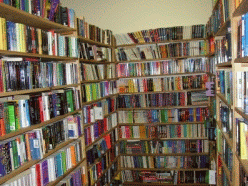
Overall Rating: 4
Location: 4
Organization: 3
Selection: 5
Cleanliness: 3
Price: 4
Brused Books is a book lover's haven on Main street, Pullman, Wash. It's easy to find and conveniently located near two coffee shops for people interested in an afternoon of literature and lattes.
The entry way is open, but from there on, a long aisle leads customers into the store. The aisle is formed by tall, overflowing bookcases. This creates a whimsical atmosphere, like the shop could be on Diagon Ally. The books are well organized into small sections like nooks. Books lie on the floor, which adds ambiance, but doesn't give an air of cleanliness. The overwhelming amount of books makes for great browsing, surprising finds and overall great selection.
Book prices are fair and there are $1 book racks. For the most part, books are sold at half of original retail value. Other prices are written on the inside of the front cover. The store will accept books in exchange for in-store credit or cash.
Store hours are Monday-Friday 11 a.m. - 6 p.m., Saturday 10 a.m. - 6 p.m. and Sunday 12 - 5 p.m.
Subscribe to:
Posts (Atom)